


What This Product Is For
Not every display wall needs to be flat. In fact, a lot of the interesting ones aren't.
Standard LED modules are rigid by design. They're great for big rectangles on walls, but the moment someone asks for a column wrap, a wave, or a curved ribbon that flows across a ceiling, those rigid modules become a problem. The usual workaround is to build faceted shapes-lots of flat panels angled at each other to approximate a curve. It looks choppy. The seams are visible. And it never feels seamless.
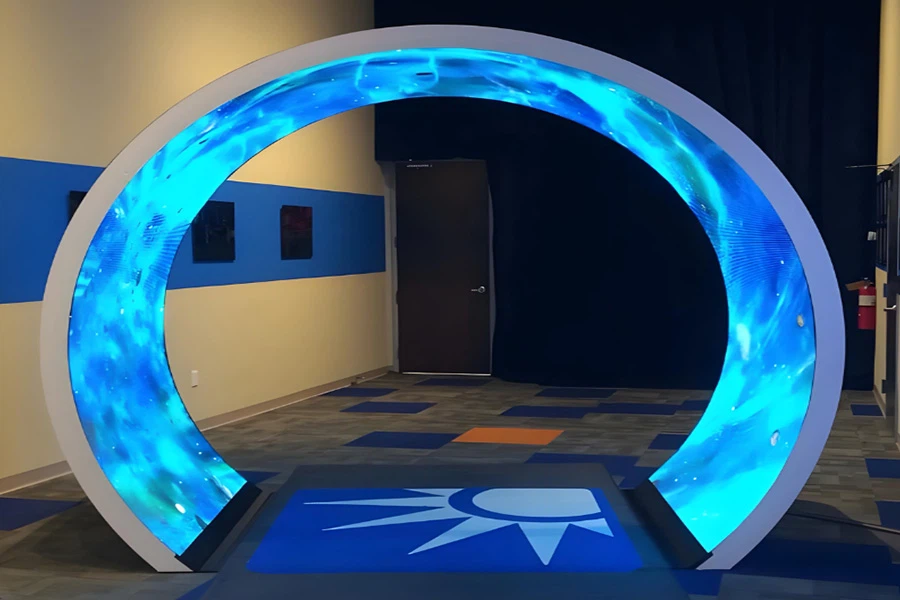
This module solves that because it's not rigid. The circuit board is made from a flexible polymer instead of fiberglass. The back cover uses silicone instead of hard plastic. The whole thing bends. You can wrap it around a pillar, shape it into an S‑curve, or make a cylinder that people can walk around. And when it's curved into place, it still delivers the same image quality as a flat panel-6000:1 contrast, 3840Hz refresh, and 14‑bit grayscale.


One Module Stock, Any Curve You Need
Walk into a job with three different column sizes-some 150mm wide, others 250mm or 350mm. With conventional curved cabinets, you'd need three separate production runs and three separate spare part bins.
Not here. The flexible modules don't care what radius you're building. You use the exact same module type for a narrow 150mm column, a medium 250mm one, and a wide 350mm pillar. The only thing that changes is the steel support frame behind the modules-a local fabricator can bend that to your spec.
For rental companies, this changes the math. Instead of stocking radius‑specific curved cabinets that sit unused 90% of the time, you stock one SKU of flexible modules. A client calls with a non‑standard curve? You don't send them away. You just have a frame shop weld the required radius and mount the same modules you already own.
The Build: What Actually Makes It Bend

Three parts do the heavy lifting.
The circuit board. Standard LED modules use a hard fiberglass board. Try to bend that, and the copper traces crack. This module uses a flexible polymer board that's been cycle‑tested for repeated bending without electrical failure.
The back cover. Silicone, not hard plastic. Plastic would take a permanent set or crack under stress. Silicone stays soft, returns to shape, and adds natural grip against the mounting frame.
The magnets. Embedded directly into the silicone. Strong enough to hold the module securely to any ferrous metal frame, but not so strong you need tools to remove one. A suction cup from the front pulls it right off.
The thickness. Under 7.8mm across most models. That thinness matters when you're wrapping tight radii-a thinner panel follows the curve more smoothly and shows less faceting between modules.
Six Forms This Module Can Take
A flat panel is one shape. Here are six more.

Full column wraps. Round or square columns-the module bends consistently around the entire perimeter. The seam stays tight even on tight curves. Several retail clients have turned blank structural columns into rotating ad displays.
Wave walls. A continuous surface that rolls from concave to convex and back again. No visible breakpoints where the curve changes direction. Science museums and tech lobbies use these as entrance statements.
Free‑standing cylinders. A full 360° display that viewers can walk completely around. Car launches and product unveilings use these for surround viewing. The modules wrap the cylindrical frame with no visible vertical seams.
Single‑surface S‑curves. Inward on one side, outward on the other, one continuous panel. With rigid cabinets, you'd need two different product families. One flexible module does both in a single run.
Near‑spherical structures. Multiple flexible panels arranged into a dome‑like form. The modules adapt to double curvature-complex geometry that flat panels can't touch.
Architectural accents. Quarter‑round corners, soft arcs, halo rings around ceiling fixtures. Places where you'd never consider putting a screen before, because rigid panels simply couldn't fit.
Where these have been installed

Shopping center column transformation. A regional retail property had load‑bearing pillars that ran right through their main atrium. They used to be plain concrete-visible, but ignored. After wrapping each pillar with flexible modules, the property now sells that column space to local advertisers as rotating digital signage. What was once a structural nuisance now generates monthly revenue.
Science museum wave wall. An interactive science museum wanted a dramatically curved entry display that flowed like a ribbon. A flat screen would have looked like a monitor mounted on a curved wall-a mismatch. The flexible modules were attached to a custom‑bent steel frame that exactly matched the architectural wave. Visitors now stop at the entrance before they even buy a ticket.


Concert stage double curve. A touring production needed a backdrop that was concave on the left half and convex on the right, forming a single continuous surface. With rigid cabinets, this would have required two separate curved cabinet types meeting at a visible seam. One flexible module spanned the transition with no seam at the inflection point.
Auto show cylinder. A car manufacturer presented a new model on a rotating turntable surrounded by a 360° cylindrical screen. Rigid panels would have left a visible joint every few degrees. The flexible modules wrapped the frame smoothly, and the cylinder showed the car from every angle simultaneously.


Airport lounge pillars. A premium passenger lounge had decorative pillars that served no functional purpose. The operator installed flexible modules on each pillar, then sold advertising placements to luxury brands targeting business travelers. The pillars now pay for themselves.
Common questions
Q: How tight of a column can this module actually wrap around?
A: It depends on your pixel pitch. The 1.2mm version reaches about 110mm diameter-think of a typical street sign pole. Larger pitches like 3mm or 4mm have larger minimums, around 400mm. The data sheet gives you the exact number for each model.
Q: Does one module handle both inward and outward bends?
A: Yes. The same module curves both directions from flat. Maximum is 120° either way-that covers S‑shapes, wave walls, and most architectural curves.
Q: Will this hold up outside, or is it strictly for indoor use?
A: Indoor only. Temperature range -10°C to 50°C, humidity 10‑90% non‑condensing. If you need an outdoor flexible panel, the factory offers a weather‑sealed version.
Q: What happens when a panel fails on a curved section-can I swap it without dismantling everything?
A: Same as a flat wall. A suction cup on the module face, a firm pull, and the magnets release. Unplug the ribbon cable, plug in the replacement, press it back. The rest of the wall continues running while you do this. Takes about a minute.
Q: How quickly can I get the curved steel support structure made?
A: The flexible modules themselves ship from our stock. The steel frame is typically done by a local metal fabricator. We provide detailed engineering drawings based on your dimensions and radius-take those to any competent shop.
Hot Tags: curved outdoor LED screen, China curved outdoor LED screen manufacturers, suppliers, factory, curved video wall displays, curved led screen wall, curved led display screen, curved led screen, Curved Led Display Wall, Curved Outdoor Led Screen


