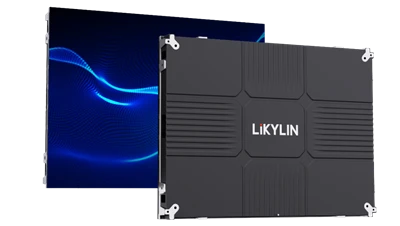
A display that bends without breaking
Most LED screens are rigid. You get a flat panel, and that's it. If you need a curved surface – a column wrap, a wave, a cylinder – you're out of luck unless you custom‑build something expensive.
The Curved LED Display Wall solves that. It's built around a flexible PCB and a soft silicone back cover. The whole module bends. Not just a little – up to 135° in either direction. You can wrap it around a pillar, curve it into an S‑shape, or create a wave that no flat screen could ever achieve. And when you're done, it still delivers 6000:1 contrast and 3840Hz refresh.


What makes it flexible
The secret is in two things. First, the circuit board is a flexible material, not the usual rigid fiberglass. It bends without cracking the traces. Second, the back cover is made of silicone, not hard plastic. That silicone gives it the ability to twist and curve without breaking or losing its shape.
The modules are also very thin – less than 7.8mm. That matters when you're wrapping a tight radius. The thinner the module, the smaller the pillar you can cover.
The back has built‑in strong magnets. Installation is straightforward: put the module against the steel frame, and the magnets hold it in place. No screws on the front. When you need to remove a module for maintenance, you pull it off from the front – no need to access the back. That's a big deal when the screen is wrapped around a pillar with no rear access.
How much can it bend?

The module can curve to a minimum diameter of about 110mm for the smallest pitch models, and larger diameters for other pitches. In practical terms, you can wrap it around a pillar as thin as a traffic pole. The bending range goes up to 135° in both concave and convex directions – that's more than enough for most creative designs.
We've seen people build cylindrical screens, wave walls, S‑curves, and even spherical‑like structures. The silicone back cover doesn't crack or crease, and the flexible PCB has been tested to withstand repeated bending without breaking electrical connections.
Picture quality isn't sacrificed
When people hear "flexible", they sometimes think the image will be soft or distorted. Not here. The LED chips are standard SMD 3‑in‑1, same as any good indoor display. Contrast is 6000:1. Refresh is 3840Hz – no flicker on camera. Grayscale goes up to 14‑bit, so gradients are smooth.
Brightness ranges from 450 to 700 nits depending on the pixel pitch. That's plenty for indoor use – conference halls, showrooms, museums, TV studios.
Pixel pitch options go from 0.9mm up to 4mm, with module sizes including 320×160mm, 200×150mm, 240×120mm, 250×125mm, and 320×180mm. You can mix different sizes in the same wall if needed.
A few things worth knowing

Magnetic mounting saves time. One person can install an entire wall. Push the module against the steel structure, and the magnets snap it into place. No screws to align, no tools. When you need to replace a module, pull it off from the front – it's held by magnets strong enough to stay put but not so strong that you need a pry bar.
The silicone back doesn't dry out. Cheap flexible materials can harden and crack after a few years. The silicone used here is formulated for long‑term flexibility. It stays soft and pliable even after years of being curved.
You can mix curved and flat modules. Sometimes only part of a wall needs to bend. The rest can be standard flat modules. They share the same pixel pitch and electrical interface, so they work together seamlessly.
Common questions
What's the smallest radius I can bend this to?
That depends on the pixel pitch. For a 1.2mm pitch module, the minimum diameter is about 110mm. For larger pitches like 4mm, it's around 400mm. Check the spec sheet for your exact pitch.
Can I bend it after installation?
The modules are designed to be installed already curved. You don't bend them repeatedly like a hinge. Once you set the curve and mount it, it stays in that shape.
Do I need a special frame?
Yes – you need a curved steel structure that matches your desired radius. The magnets work on any ferrous metal surface. We can provide design guidelines for the frame.
How do I replace a module in the middle of a curved wall?
The same as a flat wall. Use a suction cup to pull the module off from the front. The magnets release with a firm pull. Then unplug the ribbon cable and power, plug in the new module, and press it back. The rest of the wall stays running.
Is it outdoor rated?
No, this is an indoor product. Operating temperature -10°C to 50°C, humidity 10‑90% non‑condensing. For outdoor flexible screens, ask about the outdoor version.
Hot Tags: curved LED display wall, China curved LED display wall manufacturers, suppliers, factory, curved video wall displays, curved led screen wall, curved led display screen, curved led screen, Curved Led Display Wall, Curved Outdoor Led Screen