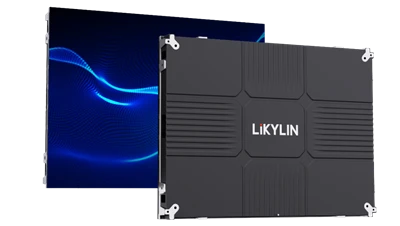
Product Introduction

Let's be honest: most LED displays claim to be "for command centers." But when you install them, the power bills spike, the back is a mess of cables, and after a year you start seeing dead pixels.
That's why the CA Series was engineered around three specific problems: wasted power, messy cabling, and early pixel failure. This flip-chip COB MicroLED display module hits 1000 nits after calibration – about 40% brighter than typical indoor displays – yet draws only 256W/m² at 600 nits. That's 22% less power than conventional COB solutions.
Why does that matter? For a 10m² wall running 24/7, that 22% saves roughly 6,500 kWh per year. At $0.12/kWh, you keep about $780 annually. Over five years, nearly $4,000 – real money.
High-Brightness MicroLED Display Module: 1000 Nits After Calibration

Most indoor LED displays claim "high brightness" but drop off quickly after calibration. The LiKYLIN CA Series MicroLED display module hits 1000 nits after calibration – about 40% higher headroom than typical displays. You can use this MicroLED display module with the lights on in a conference room with daylight coming through windows, or a control room where operators need overhead lights to read documents. The screen stays readable. You don't have to dim the room.
One integrator told us they used to install SMD walls that looked great in the dark but washed out as soon as someone turned on the lights. With the CA Series, that complaint stopped.
Low-Power MicroLED Display Module: 22% Energy Savings

Here's the calculation I run for every client considering this high-brightness low-power MicroLED display module.
At 600 nits brightness (which is plenty for most indoor environments), this CA-E common cathode LED module draws 256 watts per square meter. Conventional COB displays doing the same brightness typically pull around 330 W/m². That's a 22% difference.
Take a 10 square meter wall – common size for a medium command center. Run it 24 hours a day, 365 days.
- Conventional COB: 330W × 10 = 3.3kW × 24h × 365 = 28,908 kWh/year
- CA-E: 256W × 10 = 2.56kW × 24h × 365 = 22,426 kWh/year
- Difference: 6,482 kWh/year
At the US average commercial rate of $0.12/kWh, that's $778 saved per year. Over five years, nearly $4,000 – enough to pay for a significant chunk of the display itself.
And lower power means less heat. Less heat means your HVAC doesn't work as hard. In a room with multiple displays or servers, that adds up.
High-Contrast MicroLED Display Module: 20,000:1
I've seen too many spec sheets claim "high contrast" that looks gray in a dark room. The CA Series uses flip-chip COB with a black encapsulation layer between pixels. The result: 20,000:1 contrast. For a MicroLED display module intended for dark environments, this makes a real difference. Blacks are actually black – not dark gray.
In a command center after hours, when ambient lights are low, operators can stare at the screen for hours without eye strain. Maps, radar feeds, video streams – all sharp. No halos around text.
Flicker-Free MicroLED Display Module: 3840Hz Refresh

If you're in broadcast or live events, you know the pain. Point a camera at a cheap LED wall and you get rolling bands, scan lines, or flicker that you can't fix in post.
3840Hz is well above the threshold for broadcast cameras (typically 2400Hz required for flicker-free). That's why this MicroLED display module is trusted in studios. We've had clients in university media centers and local TV stations replace older walls with the CA Series and immediately stop getting complaints from camera operators.
Easy-Install MicroLED Display Module: Plug-in Design
Open the back of a typical LED wall. Ribbon cables everywhere. Power wires dangling. It's a nightmare to trace a faulty connection.
The CA Series uses a plug-in connection system. Modules snap together with hidden connectors. No exposed cables between modules. The back of the wall is clean. Installing this LiKYLIN CA Series MicroLED display module is faster – a two-person crew can hang 20–30 cabinets per day with basic tools. Troubleshooting is simpler: pull a module, swap it, done.

The cabinet is 32.6mm thin and weighs 3.9kg. That's about 41% thinner than conventional cabinets. You can mount it flush to a wall without building a deep service corridor. Need front access? Order the front-maintenance option. Modules pop off with a magnetic suction tool from the front – no rear space required. Perfect for retrofit projects where you can't tear down walls.
Technical Specifications Comparison
| Parameter Name | CA0.9 / CA0.9E | CA1.2 / CA1.2E | CA1.5 / CA1.5E |
|---|---|---|---|
| LED Type | Flip-Chip COB | Flip-Chip COB | Flip-Chip COB |
| Pixel Pitch (mm) | 0.9375 | 1.25 | 1.5625 |
| Cabinet Resolution (W×H) | 640 × 360 | 480 × 270 | 384 × 216 |
| Cabinet Size (mm) | 600 × 337.5 × 32.6 | 600 × 337.5 × 32.6 | 600 × 337.5 × 32.6 |
| Cabinet Weight (kg) | 3.9 ± 0.05 | 3.9 ± 0.05 | 3.9 ± 0.05 |
| Brightness (nits) | ≥1000 (Calibrated) | ≥1000 (Calibrated) | ≥800 (Calibrated) |
| Contrast Ratio | 20000:1 | 20000:1 | 20000:1 |
| Refresh Rate (Hz) | 3840 | 3840 | 3840 |
| Horizontal / Vertical Viewing Angle | ≥170° / ≥170° | ≥170° / ≥170° | ≥170° / ≥170° |
| Max Power Consumption (W/㎡) | ≤380 / ≤320 | ≤380 / ≤320 | ≤340 / ≤320 |
| Average Power Consumption (W/㎡) | ≤120 / ≤100 | ≤120 / ≤100 | ≤110 / ≤100 |
| Input Voltage | AC100~240V, 50/60Hz | AC100~240V, 50/60Hz | AC100~240V, 50/60Hz |
| Operating Temperature | -10~50°C | -10~50°C | -10~50°C |
| Operating Humidity | 10%~60% (No Condensation) | 10%~60% (No Condensation) | 10%~60% (No Condensation) |
Note: Parameters can be adjusted according to specific needs. Dual backup, single card & power, and 3-in-1 HUB options available.
Key Advantages vs Traditional LED Screens:
Up to 66% brightness increase and 22% lower power consumption at 600 nits.
Ultra-thin die-cast aluminum cabinet (≤32.6mm) for space efficiency.
Plug-in connection design with no exposed cables.
High 20,000:1 contrast ratio and 16:9 golden ratio cabinets.
Brand Strength and Quality Assurance


We've been building LED displays for years – R&D in Shenzhen, factories in Chongqing and Jiangxi. Every MicroLED display module from the CA Series gets a 72-hour burn-in before shipping. CE, RoHS, FCC certified. 60+ patents. Global projects from Azerbaijan 28 Mall to the Hong Kong Exhibition Hall. This makes the CA Series an ideal MicroLED display for command centers demanding 24/7 reliability.
Frequently Asked Questions (FAQ)
Q: How long until I see dead pixels? With flip-chip COB, there are no bonding wires to break or corrode. That's the #1 failure point in SMD displays, and it's why the CA Series MicroLED display module is trusted for long-term deployments. Realistically, you should get 8–10 years with minimal pixel loss. We have COB walls in the field approaching 7 years with no visible dead dots.
Q: Can I install it myself or do I need a specialized integrator? You don't need a specialized integrator, but you do need someone comfortable with basic rigging and networking. The plug-in connections make assembly straightforward. We provide detailed CAD drawings and can do remote commissioning.
Q: What's the catch with front maintenance? No catch. It's a mechanical design – magnetic modules held in place. You order it upfront because the cabinet structure differs slightly. Cost adder is minimal, especially compared to building a rear access corridor.
Q: Does the 22% energy saving apply at all brightness levels? The percentage varies, but the common cathode advantage holds across the brightness range. At lower brightness (300–400 nits), the difference can be even larger because the power supply efficiency curve favors common cathode. At 1000 nits, it's still about 15-18% better than common anode.
Q: What certifications and warranty does the CA Series carry? The CA Series MicroLED display module carries full CE, RoHS, and FCC certifications. We offer a standard 3-year warranty on modules and cabinets, with extended options available for large projects.
Q: What if I need a weird resolution, not standard 2K/4K/8K? The controller can scale, but we recommend designing with whole cabinets. You can also request custom cabinet sizes for large projects – we do OEM for some integrators. Contact us for a custom MicroLED display module layout and quotation.
Hot Tags: microLED display module, China microLED display module manufacturers, suppliers, factory, led screen indoor, tiny led display, 8k Video Wall, transparent microled, Micro Led Display Panel, Microled Display Module